It’s All in the History: Why Understanding Your Allotment’s Legal Status Matters
At first glance, it seems obvious — if your allotment has been around for decades, surely it must be protected under the Allotments Acts, right? Unfortunately, the reality is far more nuanced.
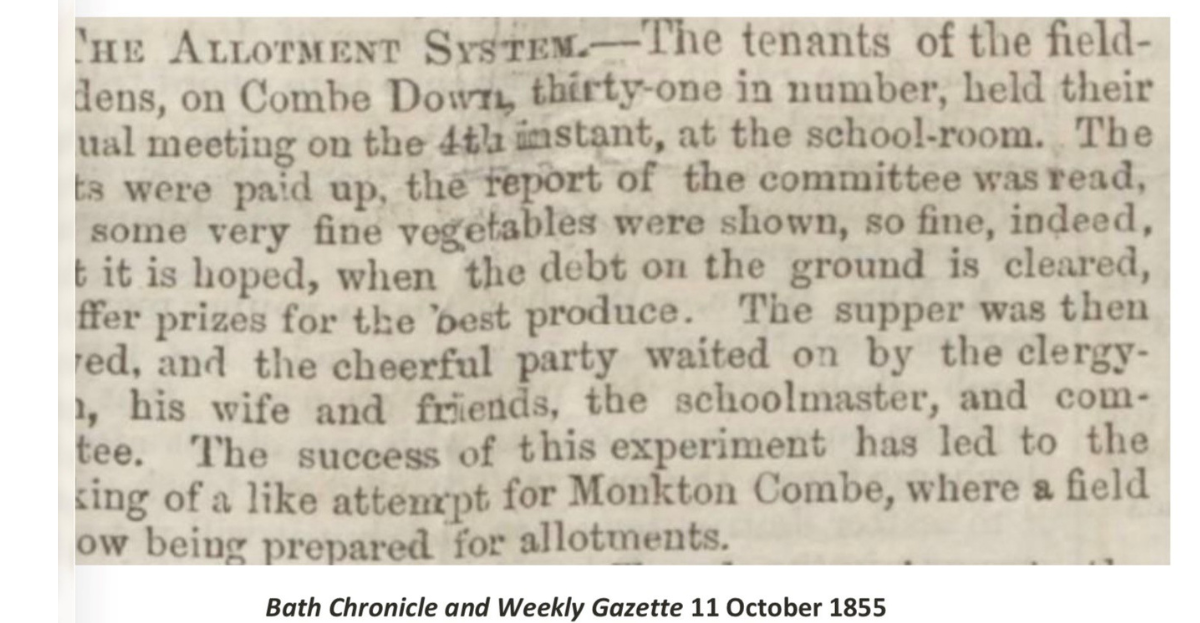
Caption:
Old Newspapers are held in most Archives or even on-line. They give a fascinating picture of past allotments. This is an extract from an excellent research paper called “A History of Combe Down Allotments” researched and written by Jacqueline Burrows in 2023. The full document can be seen here
When I first agreed to draft a guide on protecting allotment sites, I soon realised just how complex the issue can be. Although it is easy to assume that any allotment site with a long history is protected under the Allotments Acts, the legal position is often much less clear.
Allotments Act
Section 8 of the Allotments Acts 1925 only applies to land that a local authority has formally purchased or appropriated for use as allotments. Simply being on the map, or in use for many years, does not automatically confer statutory protection. This means that even long-established plots can be at risk if their legal history isn’t clear.
Caption: This extract is from a Parish Council minute book. It gives important evidence of acquisition of land for allotments. The meticulously written minutes give a fascinating glimpse of the past!
.jpg)
Site Status
Finding out the status of your site often requires digging into its past. Writing to the council is an obvious first step, but many allotment services operate with minimal staff, and rural sites may be overseen by busy parish clerks. Requests for detailed legal information may take time and could even incur costs if internal legal advice is required. Nevertheless, asking for a list of statutory allotments managed by the council is a useful starting point — if the response is unhelpful or non-existent, it’s time to take matters into your own hands.
Historical Records
Historical records are invaluable in this process. Land Registry searches (currently £14) show who owns the land and under what terms, revealing whether the council holds freehold or leasehold rights. But ownership alone isn’t enough. Understanding why and when the land was acquired is critical. Historic Ordnance Survey maps and council committee minutes held in local archives, can reveal whether a site was purchased specifically for allotments. There’s something almost magical about browsing old, hand-written records — the dusty maps, the fragile minutes — that brings the history of a site to life.
.png)
Statutory Allotments
The evidence you uncover will determine the level of protection your allotment enjoys. In some cases, council committee minutes confirm that the land was purchased for use as allotments. In these situations, you can send this documentation to the relevant council department requesting confirmation that the site is “statutory” under Section 8 of the Allotments Act 1925. You may not always get a reply, but having this evidence places you in the strongest possible position. A Freedom of Information request can be used as a last resort. It’s important to remember, however, that the Secretary of State can still approve disposal of statutory allotment land , so vigilance is still needed.

Temporary Allotments
In other cases, the minutes may reveal that the site was acquired for an alternative purpose, such as a burial ground. Even if the plot has been in use for decades, it is then classed as “temporary” and is not protected under the Allotments Acts. Sites in this category are more vulnerable and, sadly, some have been lost over the years.
Leasehold sites add another layer of complexity. If the Land Registry shows the site is held under leasehold, it’s essential to obtain a copy of the lease from the council. For older sites, the original lease may be held in local archives. The terms of the lease — including any break clauses — can be critical to the site’s long-term security.
If you are unsure of any of the particular clauses of the lease, you can email ou can email the NAS to seek support in reviewing lease agreements.
Other Safeguards
Even if the statutory status of a site is uncertain or it is considered temporary, other legislation can provide important protections. Planning laws and the Localism Act 2011 can be used to safeguard allotments and prevent unwanted development, offering another layer of security for the community. These measures will be explored in detail in the next blog post.

History
Understanding the history and legal status of your allotment is more than an academic exercise — it is a vital step in safeguarding these cherished community spaces. Every plot has a story and uncovering that story is key to ensuring these green spaces continue to thrive for generations to come.
Written by Jacky Wilkinson
SW Region
Join The National Allotment Society
Become a National Allotment Society member and help to preserve and protect allotments for future generations.
You'll also gain a range of benefits including free liability insurance, initial legal support, expert advice and much more.

Non Member Newsletter Signup

National Society of Allotment & Leisure Gardeners Ltd
Registered in 1930 under the Industrial & Provident Societies Acts no. 11144R
VAT No. 1212930 14
Patron His Majesty King Charles III
© 2022-2023 National Society of Allotment & Leisure Gardeners Ltd